

I’ve been playing video games since I was a kid, so I’ll borrow a term from back then. As of 2023, there were 117,000 businesses that made over a million dollars with no employees - a huge accomplishment, but they were playing the game on “hard mode.” No AI, no leverage, limited tools, and a decade or more of grinding.
The entrepreneur who gets started today gets to play a completely different game.
Who are they
They are not who you’d picture.
Top industries by number of firms crossing $1 million with no employees:
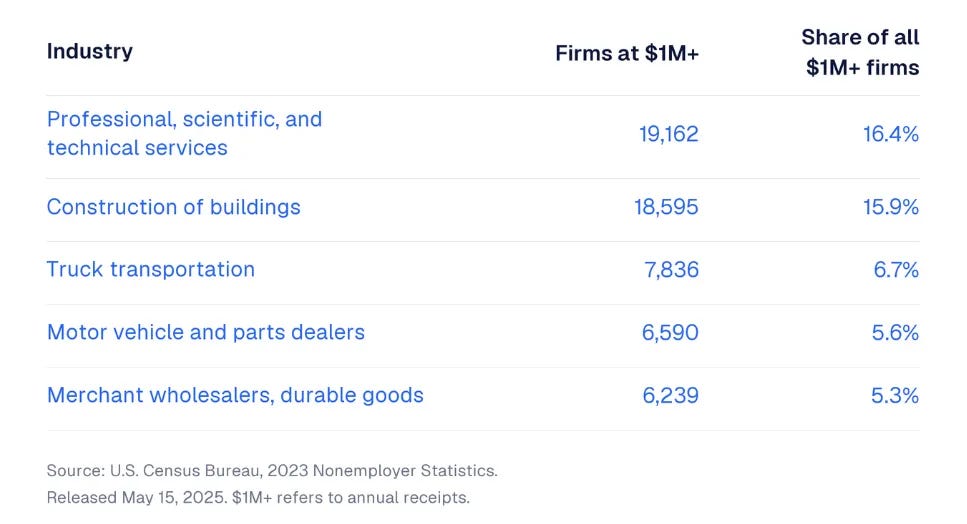
If you are anything like me - you might’ve expected to see more tech-driven categories with folks wearing Converse and hoodies - but - it’s quite the opposite. Professional services might lead, but what came after surprised me. It’s made up of more traditional categories that usually don’t get much attention.
When you zoom to the highest-end of the spectrum (firms clearing $5 million or more), you’ll find the majority of them are made up of financiers and entertainment. So, money and fame; no surprise there, I guess.
But, they took a long time to get there. For about two thirds of them, it’s taken more than a decade (and for half of those businesses, it took more than two decades!).
In 2023 there were 30.4 million nonemployers. Out of that, 117,060 businesses made over a million. About 1 in 260. Most nonemployers are tiny, so this cohort gives us something to shoot for.
That's what the map looks like. Now here's what it cost to walk it.
What hard mode actually required
Hard mode: building a business that cleared seven figures with no employees, without AI. No leverage, no headcount, limited tools. And, a decade or more to do it. Every function inside your own capability, and everything outside it paid for with other people’s time.
Although I haven’t built a $1M+ independent business myself (yet), I know what that boundary feels like, because I spent nine years building my last company the old way.
I was the business guy, so my boundary of what I could and couldn’t do was pretty clear to me (even though it felt like it was ever-expanding). Started with the typical things like strategy (brand positioning and all of the other fun stuff that we love to think about but doesn’t get us very far) and numbers (modeling, accounting, payments, and counting beans). When I needed design, I taught myself Illustrator. When my co-founder asked me to QA something, I first had to look up what that even meant, but then I taught myself how to do it and then did it - no questions asked. When I needed something more niche, I had to learn it from zero. If it was learnable in a reasonable amount of time, I learned it... because if I didn’t, then who would?
Outside my boundary was software development. I could have learned to code, but what I couldn’t do was figure out how it’d be worth it. For me - I thought the learning curve was too steep, the time to competence too long, and the cost of that time too high against everything else the business needed from me - especially in the early days. The math said no, and, in the end, the math was right.
Here’s what I’d tell you now that I didn’t fully appreciate then. Now that I can reflect back on that time, I see the boundary as a highly beneficial. It set my scope. It killed a hundred tempting ideas before I wasted a week on them, because they were outside the line and someone else’s job. My limitations made the decisions for me, and I got to spend my hours on the work that only I could do instead of on choosing the work.
Development was a dependency, so we built a team around it. That team, and everything else about running Novo the old way, is a story for a different piece.
What matters here is the boundary itself. I ran a company the old way, with a team and a clear sense of where my own limits were. Then I stepped back from running it and took a sabbatical with my wife and daughter in August 2025.
But, now that I’m getting back into the arena and dusting off my previous capabilities, things feel different. When I looked at that same boundary again, it wasn’t where it had been.
Same person. Same limits. Different physics.
So why is any of this about to change?
Why hard mode is over
The work didn’t disappear. It moved inside the boundary.
The dependency that used to force a hire is now something I can work with directly. Historically, the path from idea to product was typically owned by an engineer. And, if you weren’t an engineer then you had to find one to help you through that journey. Now with AI, not only has the distance between idea and product compressed, but also has the need for external resources other than you.
The line that used to make a decision for me wasn’t in the same place anymore. This has been both the most liberating and terrifying experience of my adult life, because I can do anything now.
Let’s get clear on something - I’m no AI expert. But, I am a recovering startup founder that has developed a strong curiosity. I’ve worked with a lot of tools and spent some real money exploring through them.
I won’t tell you AI can run a business for you. Anyone selling something like that is optimizing for views and probably shouldn’t be listened to anyway (I only mention that because I listened to them for far too long and that’s why I’m going to be writing about it). AI accelerates the idea and it can accelerate the business when implemented thoughtfully with clear goals, context, and guard rails. It does not (and cannot) do it all for you while you sit back and put your feet up. That’s a dream and that’ll never happen, at least probably not before the robots take over anyway.
Here’s the part I’m still working out though. When you feel like you can do anything, you should not do everything. For me - I don’t have the same boundary signaling what I can and cannot do. The constraint that used to organize my time is gone, and the discipline it imposed has to come from me now.
That’s the blessing and the curse. The work got cheaper, but the choosing got more expensive. In this new game, the choice is what matters most and the advantage goes to the person who moves first.
Why you're still early
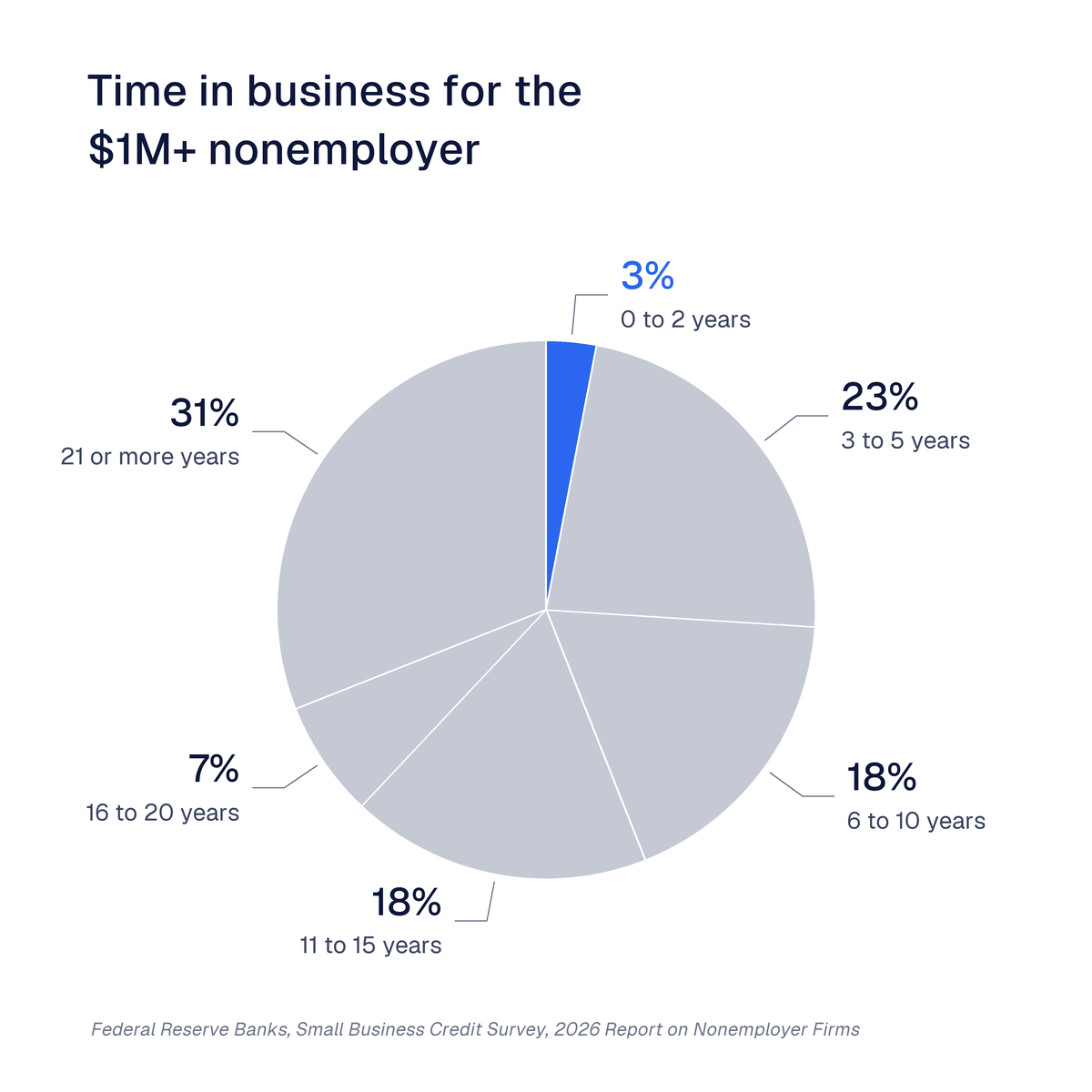
Only 3% of these businesses are 0 to 2 years old. That isn’t because young businesses can’t do it. It’s because the old path took more than a decade.
That is the proof of how early this new game still is. You are not late to a crowded field. You are early to a field that just opened and it is being defined in real-time. No matter how many AI gurus you hear on TikTok - everyone is still trying to figure it out and, more importantly, everyone is struggling to keep up.
Real talk: hard mode might be over and timelines will be quicker, but that doesn’t mean we are entering into the “easy mode” era. The work is still yours. You still need something worth building, the willingness to do it yourself, and the tolerance for doing it badly for longer than you’d like. AI will never replace that.
The next few years will produce a new cohort of businesses that looks nothing like the one from before. The tools exist, the playbooks are public, and the reasons requiring external hires are falling fast. The people who start riding this wave now won’t look early. When looking back in 10 years, they’ll look obvious.
I don’t have this all figured out. I haven’t built a $1M+ independent business myself (not yet at least). But I know it’s the most interesting topic in business right now, and I’d rather see what I can do in the arena than watch from the sidelines!
Start now
The 117,000 businesses proved something while playing a completely different game. No AI, no leverage, limited tools, no support. Every one of them built it anyway. They started with something they wanted to build and did the work under conditions significantly worse than today and continued to do it for a long time.
I challenge you to get started today. Get started by doing the smallest thing that you could think of to get you on the path. Watch that podcast, read that book, build that website, or write that draft. Whatever it is - just start the thing and come back to it again tomorrow and do it again.
If you’re building something of your own, I’d love to hear about it. I read everything, and I’m genuinely curious what people are starting right now.
Onwards and Upwards!
Sources
U.S. Census Bureau, 2023 Nonemployer Statistics, released May 15, 2025. census.gov/newsroom/press-releases/2025/2023-nonemployer-statistics.html
Other Census data found via the Census API.
Federal Reserve Banks, "2026 Chartbook on Nonemployer Firms" July 2026. doi.org/10.55350/sbcs-20260707